
201 vs 304 Stainless Steel Door Hinges: What’s the Difference?

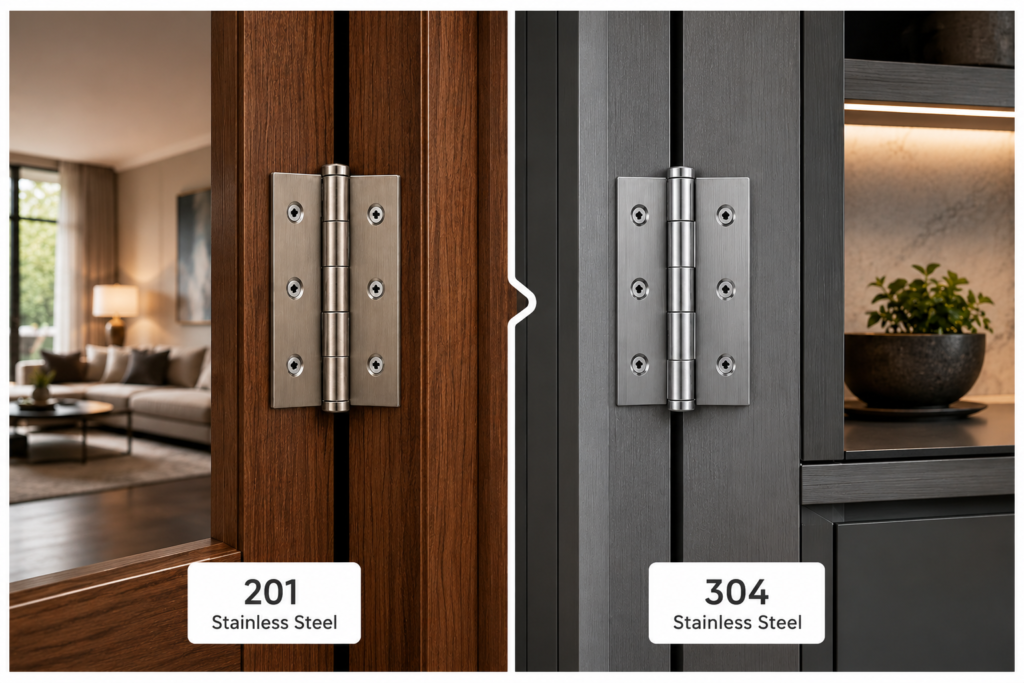
Put a brushed 201 stainless steel hinge next to a brushed 304 stainless steel hinge and, at first glance, you may not see much difference.
The size can be the same. The surface can look almost identical. Both may have a clean satin or brushed finish.
That is where the comparison gets a little tricky.
When choosing between 201 vs 304 stainless steel, the useful difference is not simply what the hinge looks like on day one. What matters more is the material specification, the environment around the door, how the hardware will be used, and what the project actually requires.
So rather than asking:
“Is 304 always better?”
I would start with:
“What does this door actually need?”
If you are still deciding whether you need a butt hinge, no-mortise hinge, self-closing hinge or concealed hinge, our guide to different types of hinges is a better place to start.
If the hinge design is already settled and material is the next question, here is what is worth knowing.
Quick Answer: 201 vs 304 Stainless Steel
Before getting into the details, here is a practical comparison.
| Point to Compare | 201 Stainless Steel | 304 Stainless Steel |
|---|---|---|
| Stainless steel family | Austenitic Cr-Mn | Austenitic Cr-Ni |
| Nickel content | Lower | Higher |
| Manganese content | Higher | Lower |
| General corrosion performance | Depends on exact grade and environment | Well-established general-purpose corrosion resistance |
| Dry interior use | Often worth considering | Suitable |
| Humid interior use | Check environment carefully | Commonly preferred |
| Cost | Generally more cost-conscious | Usually higher |
| Brushed appearance | Can look very similar to 304 | Can look very similar to 201 |
| Coastal / chloride-rich areas | Requires careful grade selection | 304 may still not be enough |
The important thing is not to turn this into:
201 = bad
304 = good
That is too simple.
A correctly specified 201 stainless steel hinge may be perfectly reasonable for a dry interior application.
At the same time, choosing 304 does not automatically solve every corrosion problem, especially when the hardware will be exposed to salt, chlorides or a more aggressive environment.
What Is the Material Difference Between 201 and 304 Stainless Steel?
Both 201 and 304 are austenitic stainless steels, but they use different alloying strategies.
304 is the familiar chromium-nickel stainless steel commonly described as an 18/8 grade — roughly 18% chromium and 8% nickel.
201 belongs to the 200-series Cr-Mn family. Compared with standard 304, part of the nickel is replaced by manganese and nitrogen.
For someone buying hinges, you do not need to memorize an alloy chemistry table.
The practical point is this:
201 uses less nickel, while 304 uses a more traditional chromium-nickel composition with a long track record as a general-purpose corrosion-resistant stainless steel.
That difference can affect material cost and how comfortably a grade fits particular service environments.
It is also worth remembering that “201” is a specific material designation — not just a cheaper-looking version of 304.
The grade should be written into the product specification rather than guessed from a product photo.
Can You Tell a 201 Hinge From a 304 Hinge by Looking at It?
Usually, not reliably.
This is one of the most useful things to understand when comparing quotations online.
Once the surface is brushed, satin finished or polished, two hinges made from different stainless steel grades may look extremely similar.
One is not necessarily going to look obviously darker.
304 does not automatically look “more premium.”
And a shiny surface does not prove that a hinge is made from 304 stainless steel.
So if two product photos look nearly identical, that does not mean the specifications are identical.
I’d use the photo to check things such as:
hinge shape;
hole pattern;
finish;
pin construction;
general workmanship; and
visible dimensions.
I would not use a photo as proof of the stainless steel grade.
The same applies to samples.
A good brushed finish tells you something about the finishing process.
It does not, by itself, confirm 201 or 304.
Our broader door hinge selection guide explains why material should be checked together with thickness, size, structure and installation requirements.
Where Does the Stainless Steel Grade Matter Most?
This is where the comparison becomes much more practical.
Dry Interior Doors
Think about a normal bedroom, apartment or office door.
The hinge spends most of its life indoors.
It is not constantly wet.
It is not sitting next to seawater.
It may not be exposed to aggressive cleaning products every day.
In that kind of environment, a properly specified 201 stainless steel hinge can be worth considering if the project allows it.
There is little value in paying for a higher specification simply because the number sounds better.
The material still needs to meet the project requirement, of course, but over-specifying every dry interior hinge is not automatically better purchasing.
Bathrooms and More Humid Interiors
Now move the same door closer to a bathroom, kitchen or other humid area.
The environment changes.
Humidity is higher. Condensation may occur more often. Cleaning can be more frequent.
This is where many buyers become more comfortable specifying 304 stainless steel because its general-purpose corrosion resistance is well established.
That does not mean the word “bathroom” automatically creates one universal material rule.
Ventilation, cleaning products, moisture level and the complete hardware specification still matter.
But the environment gives you a much stronger reason to think carefully about corrosion resistance instead of comparing only price.
Hotels and Commercial Interiors
Hotels are a useful example because hardware is not simply installed and forgotten.
Doors are opened frequently.
Rooms and corridors are cleaned regularly.
Appearance matters over a long service period.
And one hardware specification may be repeated across dozens or hundreds of doors.
For this kind of project, a small material decision becomes a much larger procurement decision.
The same logic applies to apartments, offices and other multi-door projects.
The question should be:
“Which specification can we repeat consistently across the project?”
not simply:
“Which hinge is cheapest?”
Coastal and Chloride-Rich Environments
This deserves a separate warning.
Do not assume:
“It’s 304 stainless steel, so coastal use is automatically fine.”
Chlorides create a different corrosion challenge for stainless steels.
For locations close to the sea, swimming pools or other chloride-rich environments, a project may need 316 stainless steel or another more corrosion-resistant grade.
304 can be a better-known general-purpose grade than 201, but 304 should not automatically be treated as a marine specification.
For demanding environments, follow the project specification and evaluate the actual exposure conditions before confirming the hinge material.

Is a 304 Stainless Steel Hinge Automatically a Better Hinge?
No.
This is where product comparisons often go wrong.
A door hinge is more than its material grade.
It also has:
hinge leaves;
a central pin;
bearings or washers;
screws;
fixing holes;
a specific leaf thickness;
a particular size; and
a particular manufacturing tolerance.
A 304 hinge that is too thin or poorly matched to a door is not automatically a better choice than a correctly specified hinge made for that application.
Material is one line on the specification sheet.
It is not the whole specification.
For example, one of the current ShingStar products that is explicitly specified as 304 stainless steel is our 304 stainless steel butt hinge.
That product is available in 3 × 2.5 inch, 4 × 3 inch and 5 × 3 inch formats, with 2.5 mm and 3.0 mm thickness options.
Those dimensions matter just as much as seeing “304” in the title.
The same is true for smaller hardware.
Our 304 stainless steel small cabinet butt hinge uses the same general butt-hinge principle but is offered in smaller sizes for furniture and cabinet applications.
The material can be the same.
The application is not.
Why Does 304 Stainless Steel Usually Cost More?
One reason is alloy composition.
304 contains considerably more nickel than 201, while 201 uses more manganese and nitrogen to maintain its austenitic structure with a lower nickel content.
Nickel is an important cost component in stainless steel production.
That is why, when everything else is comparable, 201 is often positioned as a more cost-conscious material option.
But there is an important phrase there:
when everything else is comparable.
Imagine two quotations.
Both say:
4 × 3 stainless steel door hinge
But one quotation is based on:
one stainless steel grade;
2.5 mm leaf thickness;
one pin structure; and
basic packaging.
The other uses:
another material grade;
full 3.0 mm thickness;
different internal components; and
different screws or packaging.
Those are not the same product simply because both quotations contain the words “4 × 3 stainless steel hinge.”
This is why comparing unit prices before comparing specifications can be misleading.
How Should You Confirm 201 or 304 Before Ordering?
If the stainless steel grade matters to the project, do not leave it as:
Material: Stainless Steel
That is too vague.
Put the Grade Into the Specification
For example:
Hinge leaf material: SUS304
or whatever grade the project actually requires.
That gives the buyer and supplier the same reference point.
Confirm the Physical Sample
Before mass production, compare the approved sample with the agreed specification.
Check:
material grade;
size;
actual thickness;
hole pattern;
pin structure;
finish;
screws; and
packaging.
Ask for Material Verification When the Project Requires It
For projects where material grade is critical, appropriate material documentation or testing can be requested.
Depending on the purchasing requirement, this may include supplier material documentation, third-party verification or analytical testing such as PMI/XRF.
The important point is not that every normal hinge order needs laboratory testing.
It is that appearance alone is not enough when material grade is contractual.
Keep the Requirement Consistent Through Production
Confirming one perfect sample is useful.
Making sure the bulk order follows the same specification is just as important.
For larger B2B orders, material, thickness, finish and other agreed points should remain part of the production and inspection requirements.
What About the Other Hinge Materials?
201 and 304 are useful to compare when the product is actually stainless steel.
But not every door hinge is made from stainless steel.
That is worth mentioning because different hinge structures can use different materials depending on their design and function.
For example, concealed and hydraulic hinge systems may use zinc alloy, aluminum alloy, cold-rolled steel or combinations of several materials.
So if you’re comparing different types of hinges, don’t assume every silver-colored hinge belongs in a 201-versus-304 comparison.
First confirm what the product is actually made from.
Then compare grades within that material family.
This simple step avoids a lot of confusion.
A Better Way to Compare Stainless Steel Hinge Quotations
If I were comparing two quotations for stainless steel hinges, I would put these items side by side:
exact stainless steel grade;
hinge size;
nominal thickness;
actual measured thickness;
pin material;
bearing or washer construction;
screw specification;
surface finish;
quantity;
packing method;
testing requirement; and
installation environment.
This makes the conversation much clearer.
Instead of asking:
“Why is your hinge more expensive?”
you can ask:
“Are these actually the same specification?”
That is usually the better question.
You can browse the current ShingStar door hinge range to compare the hinge structures currently listed on our website.
So, Should You Choose 201 or 304 Stainless Steel?
For a dry interior project where the specification allows it, 201 may be a sensible option when cost control matters.
For a more humid interior or a project where a familiar general-purpose corrosion-resistant stainless steel grade is preferred, 304 is often the more comfortable starting point.
For coastal, poolside or chloride-rich environments, do not assume either answer is enough without checking the project conditions.
And remember:
Choosing 304 does not replace choosing the right hinge size, thickness, structure and fixing method.
The useful question is not:
“Which number is better?”
It is:
“Which material and hinge specification make sense for this door and this environment?”
If you already have a drawing, existing sample or material requirement, you can send your hinge specification here. A few details — hinge type, size, thickness, material, finish, quantity and installation environment — usually make the comparison much easier.
Frequently Asked Questions
Is 304 Stainless Steel Better Than 201 for Door Hinges?
Not in every situation.
304 is a widely used general-purpose Cr-Ni stainless steel with good corrosion resistance. 201 uses less nickel and more manganese. The right choice depends on the environment, hinge specification and project requirement.
Can I Tell a 201 Hinge From a 304 Hinge by Its Appearance?
Usually not reliably.
Brushing and polishing can make the two look very similar. If material grade matters, confirm it through the agreed specification and appropriate documentation or testing.
Is 201 Stainless Steel Suitable for Interior Doors?
It can be considered for dry interior applications when the product and project specifications allow it.
The complete hinge construction, thickness and door requirements still need to be checked.
Is 304 Stainless Steel Suitable for Coastal Areas?
Do not assume that automatically.
Coastal and chloride-rich environments can require more corrosion-resistant grades such as 316 or another project-specific material.
Why Does 304 Usually Cost More Than 201?
304 contains substantially more nickel, while 201 replaces part of the nickel with manganese and nitrogen. Alloy composition is one factor behind the cost difference.
Are All ShingStar Door Hinges 201 or 304 Stainless Steel?
No.
Different hinge designs can use different materials. The current ShingStar range includes products specified as 304 stainless steel as well as other stainless steel, steel, zinc-alloy and aluminum-alloy hinge designs. Always check the specific product specification before comparing materials.
TALK TO US
Premium Furniture Architectural Hardware Manufacturer
For OEM/ODM or other B2B inquiries
Vincent | Sales Representative
Email: shingstarbusiness@gmail.com