
Types of Hinges: 6 Essential Hinge Types and Where to Use Them

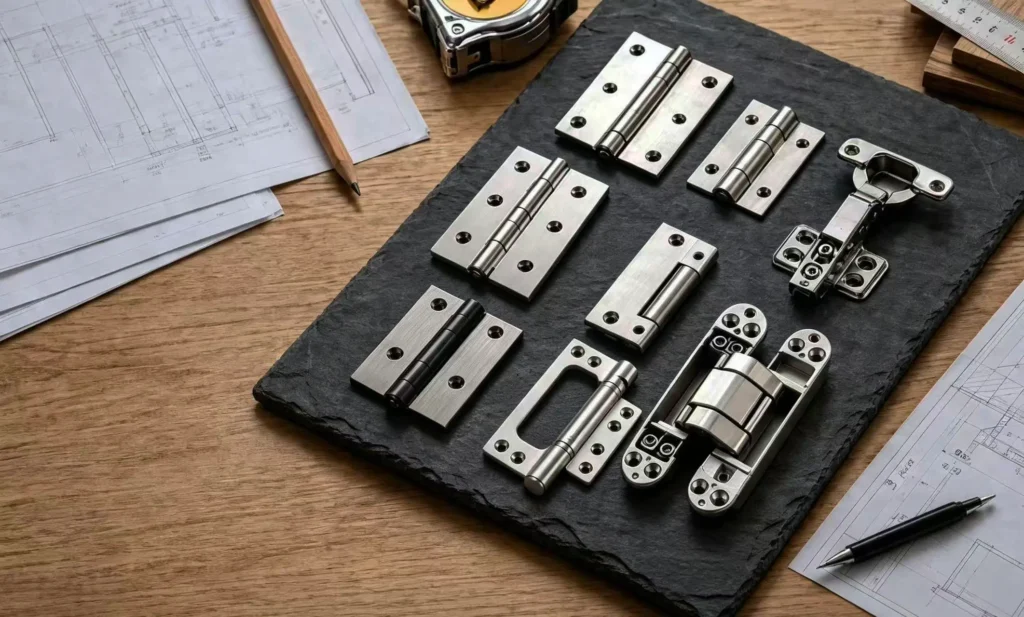
If you put several hinges on a table, they can look surprisingly similar at first.
A couple of metal leaves, a pin in the middle, a few screw holes — how different can they really be?
Quite different, actually.
Some hinges are designed to make installation easier. Some bring the door back after you let go. Some let a door swing in both directions. Others disappear completely once the door is closed.
The easiest way to understand the different types of hinges is not to memorize every name. Start with a much simpler question:
What do you need the door to do?
Once you know that, choosing a hinge gets much easier.
If you already know the general hinge type and are trying to decide on size, thickness, stainless steel grade or finish, our guide to choosing a door hinge goes into those details.
For this guide, let’s keep things simpler and look at six hinge types you’re likely to come across when working with interior doors, wooden doors, hidden doors and furniture.
Quick Guide to 6 Common Types of Hinges
| Hinge Type | Where It Often Works Well | What Makes It Different |
|---|---|---|
| Butt Hinge | Wooden and interior doors | Traditional two-leaf hinge |
| Flush / No-Mortise Hinge | Interior doors and renovation work | Less recess cutting |
| Self-Closing Hinge | Interior and wooden doors | Helps return the door after opening |
| Double-Action Spring Hinge | Café and swing doors | Opens in both directions |
| Hydraulic Soft-Close Hinge | Interior and hidden doors | Controlled automatic closing |
| 3D Concealed Hinge | Modern and hidden doors | Hidden when closed and adjustable |
There is no single “best” hinge in this table.
A hinge that makes perfect sense on a café door could be completely wrong for a bedroom door. The useful question is always the same:
Does the hinge match the door and the way the door needs to move?
1. Butt Hinges
Let’s start with the hinge most people already recognize.
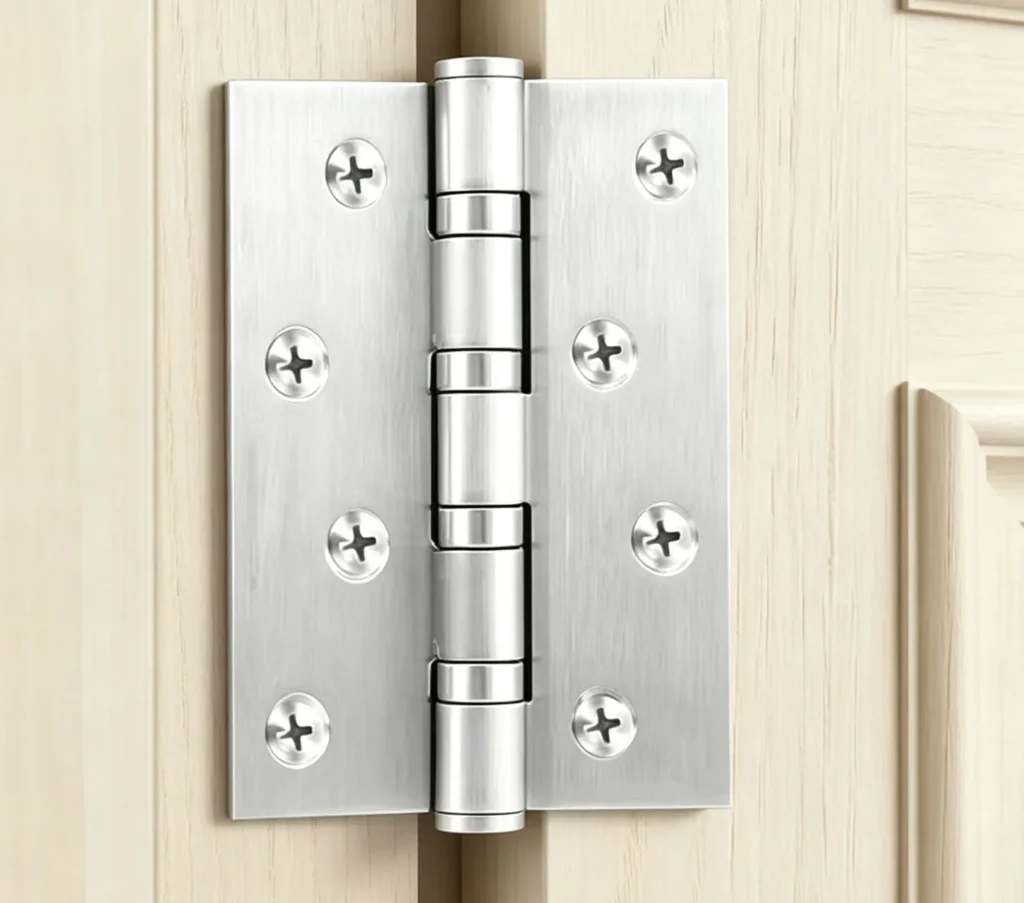
A butt hinge uses two flat leaves joined around a central pin. On a traditional wooden door, the leaves are normally fitted into shallow recesses in the door and frame.
When the recesses are cut to the correct depth, the hinge sits neatly along the door edge.
It is a simple structure, which is one reason butt hinges are so common on:
- wooden doors;
- bedroom doors;
- residential interior doors;
- solid wood doors; and
- many conventional door-and-frame systems.
But here’s something worth remembering:
Two butt hinges that look almost identical in a photo may not be the same product.
They can differ in leaf thickness, material, pin construction, bearing structure, screw pattern and finish.
For example, a 3-inch hinge intended for a relatively small door and a thicker 4- or 5-inch hinge intended for a larger wooden door may share the same basic structure but behave very differently in use.
If you want to see a typical door version, this 304 stainless steel butt hinge is a useful example.
What about smaller butt hinges?
The same basic hinge structure is also used on smaller furniture and cabinet applications.
A small 304 stainless steel cabinet butt hinge looks familiar because the basic construction is still two leaves and a central pin, but its size and intended application are different.
That’s why I wouldn’t choose a hinge just because someone says:
“I need a butt hinge.”
I’d still want to know whether we’re talking about a cabinet, a light interior door or a solid wooden door.
The hinge name gets you into the right family.
The door tells you which version inside that family makes sense.
2. Flush Hinges / No-Mortise Hinges
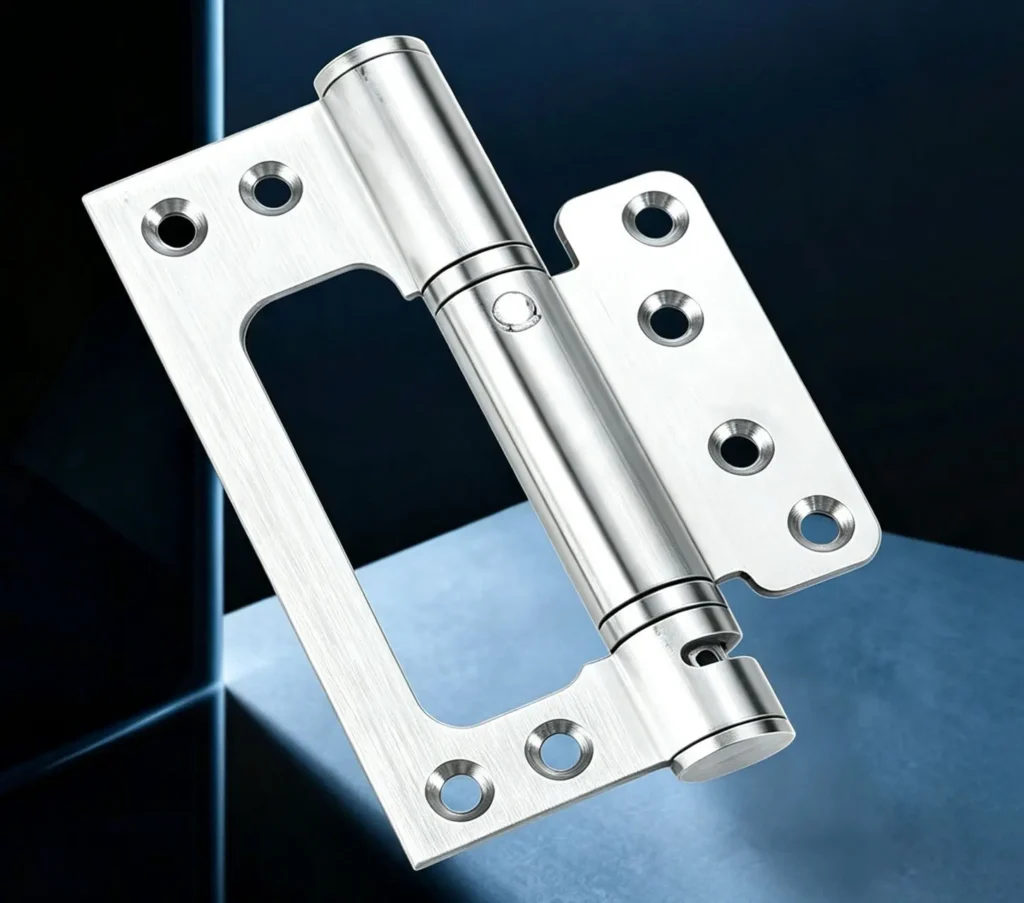
Many flush hinges are designed as no-mortise hinges, using a smaller leaf that nests into the larger leaf when the hinge closes.
That small structural difference can make installation easier.
With a traditional butt hinge, recesses are commonly cut into the door and frame so the hinge leaves sit properly.
A no-mortise design can reduce the amount of recess cutting required because the two leaves fit together rather than simply stacking on top of each other.
With a traditional butt hinge, recesses are commonly cut into the door and frame so the hinge leaves sit properly.
A no-mortise design can reduce that machining because the two leaves nest together.
That makes this hinge worth considering when:
- you want to reduce cutting during installation;
- you’re working on a renovation;
- the door surface is already finished;
- installation time matters; or
- you prefer a surface-mounted solution.
You can see the nested-leaf structure clearly on this stainless steel flush hinge.
But there’s one little trap in the name.
No-mortise does not mean no measurement.
You still need to look at door clearance, hinge thickness, screw position and the fixing area on the frame.
If the gap around the door is already tight, adding the wrong hinge thickness can create a problem even if you saved time on cutting.
So I’d think of this hinge as:
easier preparation, not automatic compatibility.
That distinction matters.
3. Self-Closing Hinges
A normal hinge lets the door move.
A self-closing hinge adds another job: helping bring the door back after it has been opened.
Imagine opening a door, letting go and having the hinge help move it toward the closed position instead of leaving the door exactly where you released it.
That’s useful in places where people regularly forget to close a door or where you simply want the door to return after use.
Depending on the design, self-closing hinges can be useful on:
- interior wooden doors;
- utility-room doors;
- hidden doors;
- residential doors; and
- other light-to-medium door applications where automatic return is helpful.
A current example is this self-closing door hinge, which uses adjustable closing force so the return action can be tuned for different installations.
One thing I’d always check is how the particular model creates that closing action.
“Self-closing” describes what the hinge does.
It doesn’t necessarily tell you everything about how the mechanism inside is built.
And, just like a normal hinge, the final choice still needs to make sense for the door weight, width and installation.
4. Double-Action Spring Hinges
A double-action spring hinge solves a very different problem.
Instead of allowing the door to open in only one direction, it lets the door swing both ways.
Push from one side and it opens.
Push from the other side and it opens again.
When released, the spring mechanism helps return the door.
If you’ve ever walked through a café-style or restaurant service door, this movement will probably feel familiar.
That’s why double-action hinges are commonly associated with:
- café doors;
- restaurant swing doors;
- service doors;
- saloon-style doors;
- kitchen swing doors; and
- some gates.
You can see an example in this double-action spring hinge.
The main thing to remember is that this isn’t simply a stronger version of a normal hinge.
It’s a different movement system.
If the door only needs to open toward one side, the two-way function may be unnecessary.
But if people need to move through from either direction without stopping to pull the door, a double-action hinge suddenly makes a lot more sense.
This is a good example of why function should come before appearance when choosing hardware.
5. Hydraulic Soft-Close Hinges
Self-closing and soft-closing sound similar, but they aren’t exactly the same idea.
A basic self-closing mechanism is mainly concerned with bringing the door back.
A hydraulic soft-close hinge adds more control to that movement.
Think about a door that snaps back too quickly after someone lets go.
Technically, it closes.
But it doesn’t feel particularly nice, and repeated slamming can also be annoying in a quiet interior.
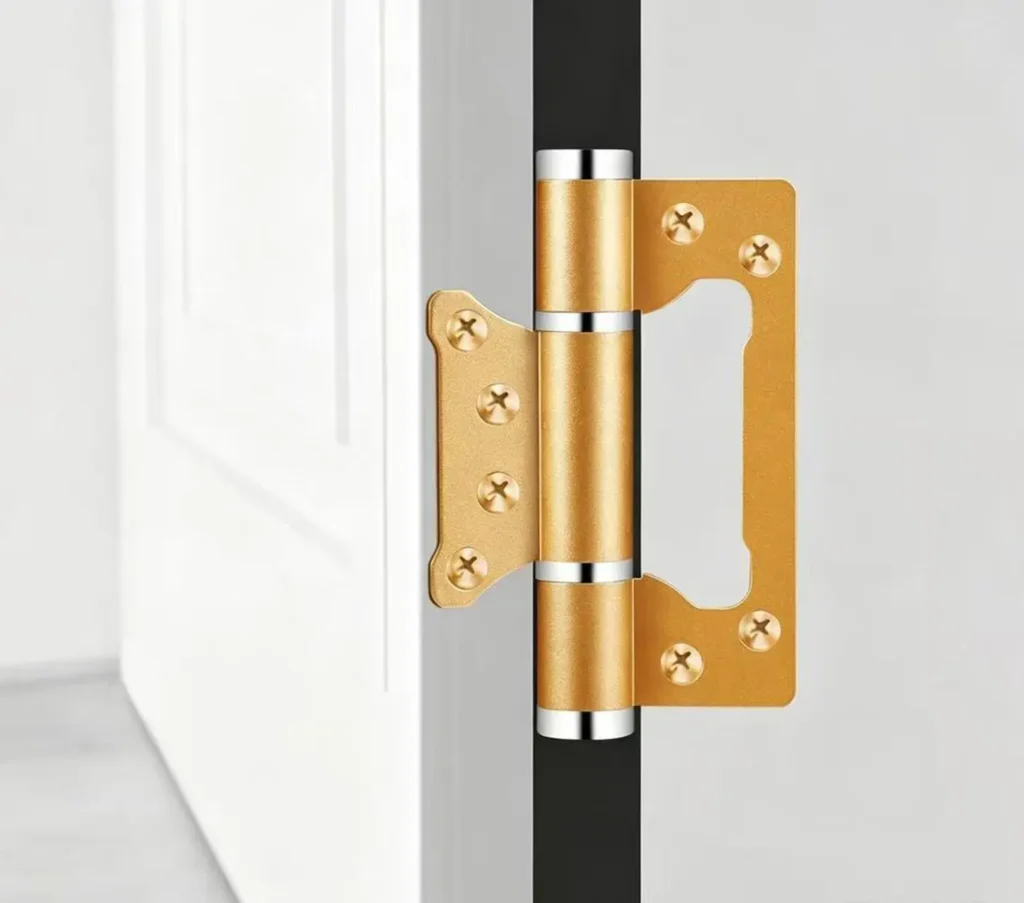
A hydraulic mechanism can help control the closing movement so the door returns more smoothly.
Depending on the particular design, this kind of hinge may make sense for:
- hidden doors;
- interior doors;
- wooden doors;
- areas where quieter, more controlled closing is preferred.
This hydraulic self-closing hinge is one example where the closing speed can be adjusted.
The useful distinction here is simple:
Self-closing answers “Will the door come back?”
Soft-close answers “How does it come back?”
Sometimes you need one.
Sometimes you need both.
And sometimes a normal hinge is completely fine.
6. 3D Adjustable Concealed Hinges
A concealed hinge is for situations where you don’t really want the hinge to become part of the visible door design.
When the door is closed, the hinge mechanism sits inside the door and frame rather than being exposed along the edge.
That’s why concealed hinges show up so often in modern interiors and hidden-door designs.
But hiding the hinge is only part of the story.
Many concealed door hinges also offer 3D adjustment.
That means the door position can be fine-tuned after installation rather than relying entirely on perfect positioning during the first fitting.
Adjustment can be especially useful when you’re trying to get:
- even gaps around a door;
- a flush door surface;
- clean alignment with a slim frame;
- better positioning after installation.
ShingStar currently has two versions that show how the same hinge category can be adapted to different door structures.
The first is a 3D adjustable hidden hinge for slim frame doors, aimed at hidden and slim-frame applications.
The second is a 3D concealed hinge for folding and interior doors, with adjustment in vertical, horizontal and depth directions.
This is also a good reminder that “concealed hinge” is still a fairly broad description.
Two concealed hinges can use different body shapes, dimensions, cut-outs and adjustment systems.
So if you’re replacing an existing concealed hinge, I’d definitely compare the technical drawing rather than trying to match it from a front-view photo.
What About Other Types of Hinges?
These six types are far from the only hinges you’ll find.
Depending on the industry and application, you may also come across:
- ball-bearing hinges;
- piano or continuous hinges;
- pivot hinges;
- strap hinges;
- lift-off hinges;
- torque or friction hinges; and
- many specialty furniture hinges.
I haven’t gone deeply into those here for a reason.
A giant list of hinge names is easy to make but isn’t always very useful.
If you’re choosing hardware for an actual door, it’s more helpful to understand the handful of designs that match the way your door needs to work.
We can always go deeper once the application becomes clear.
How to Choose Between Different Types of Hinges
When someone sends me a door photo and asks, “Which hinge should I use?”, I’d rather start with five questions than with a catalogue.
What is the hinge going on?
A cabinet door, standard bedroom door, hidden door and café swing door immediately take you in different directions.
Start there.
How should the door move?
Does it open one way?
Both ways?
Should it return automatically?
Should it close slowly?
Or should it simply stay wherever someone leaves it?
This question alone can eliminate half the wrong options.
Do you want the hinge to be visible?
If the hardware should disappear when the door closes, look at concealed hinges.
If visible hardware isn’t a problem, butt and flush hinges may be much simpler.
How much installation work is acceptable?
If the door and frame are already designed for mortised hinges, a butt hinge may be completely natural.
If you’re trying to avoid cutting a full recess, a no-mortise design may save work.
How demanding is the door?
A lightweight cabinet door doesn’t create the same demands as a solid wooden door that’s opened hundreds of times a day.
Before confirming the hinge, check the actual size, thickness, material, fixing method and any relevant performance information.
Don’t Choose From the Hinge Name Alone
This is probably the biggest takeaway from the whole guide.
A product title can tell you what family a hinge belongs to.
It doesn’t tell you the entire specification.
Before choosing or comparing hinges, I’d check:
- hinge dimensions;
- actual leaf thickness;
- material;
- finish;
- door weight;
- door thickness;
- frame construction;
- opening direction;
- screw specification;
- fixing position;
- adjustment range, if applicable;
- closing function, if applicable; and
- frequency of use.
For larger projects, it’s also worth testing one complete sample on the actual door before finalizing everything.
A drawing can tell you the numbers.
A fitted sample tells you how the door actually moves, how the gap looks and whether the installation makes sense.
That’s much harder to judge from a product photo.
So, Which Hinge Type Do You Actually Need?
There’s no need to memorize all six.
A quick way to think about them is:
For a traditional wooden door: start with a butt hinge.
Want less mortising: look at a flush or no-mortise hinge.
Want the door to return after opening: look at a self-closing hinge.
Need the door to swing both ways: double-action spring hinge.
Want a smoother controlled close: hydraulic soft-close hinge.
Want the hinge hidden: 3D concealed hinge.
Once you’ve narrowed down the structure, then move on to size, thickness, material and finish.
Our door hinge selection guide covers those next steps in more detail.
You can also browse the current ShingStar door hinge range to compare the different structures side by side.
And if you’re working from an existing hinge, a door drawing or a project specification, you can send the details here. A photo plus a few basic measurements is often the easiest place to start.
Frequently Asked Questions
What are the most common types of door hinges?
Common door hinge types include butt hinges, flush or no-mortise hinges, self-closing hinges, concealed hinges, spring hinges and specialty hinges designed for particular door movements.
Which type of hinge is best for a normal wooden door?
A traditional butt hinge is a common starting point for wooden doors, but the final choice depends on the door weight, frame structure, installation method and appearance required.
Which hinge does not need traditional mortising?
Flush or no-mortise hinges are designed so the leaves nest together, which can reduce or sometimes eliminate the need for a conventional full hinge recess.
Which hinge closes the door automatically?
Self-closing and spring hinges are designed to help return a door after opening. Hydraulic self-closing designs can add more control to the closing movement.
Which hinge can open in both directions?
A double-action spring hinge allows the door to swing in two directions and helps return it after the door is released.
Which hinge is hidden when the door is closed?
A concealed or hidden hinge is installed inside the door and frame so the main hinge body is not visible when the door is closed.
TALK TO US
Premium Furniture Architectural Hardware Manufacturer
For OEM/ODM or other B2B inquiries
Vincent | Sales Representative
Email: shingstarbusiness@gmail.com